


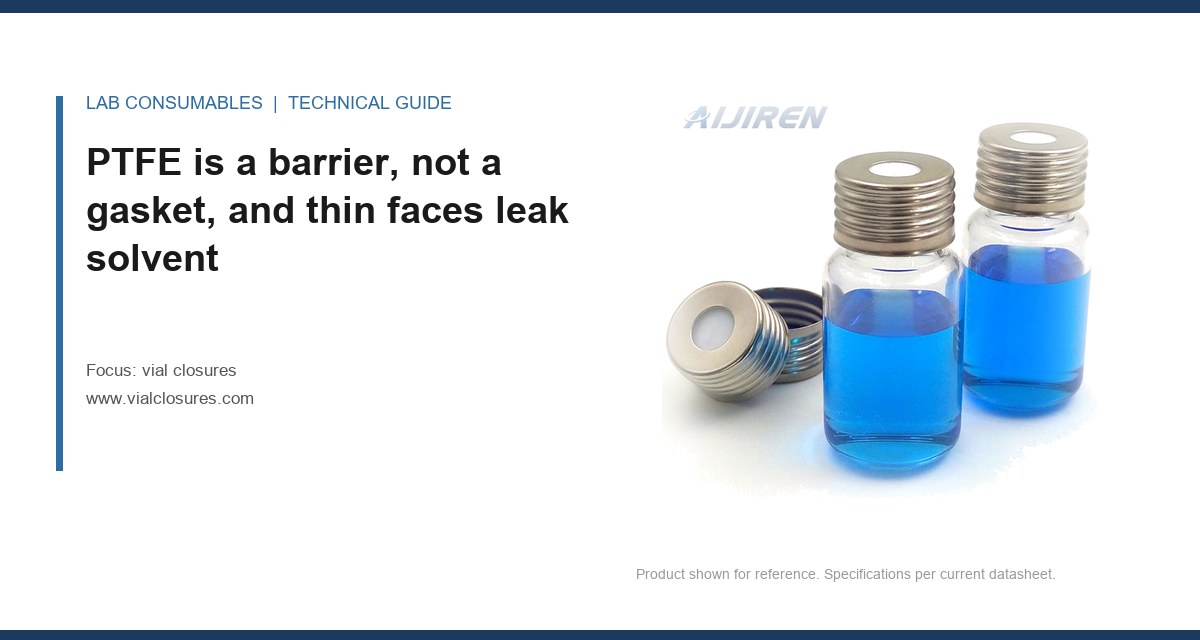
A 40 mL VOC vial set with PTFE-faced silicone septa came back from the field with toluene recoveries at 64% against a 95 to 105% acceptance window. The blanks were clean. The internal standard response was flat across every sample. The lab had run the same method for two years without a shift. The septa had been switched in the previous lot from a 0.010 in. PTFE face to a 0.005 in. face on the same silicone backing, and the thinner face was permeating enough toluene during the 14-day hold that it never reached the GC. Nothing in the certificate of analysis flagged the change. This is the failure mode that drives most of the material-selection questions I get, and it is why the choice of vial closure polymer has to be matched to the solvent, the pH, and the temperature window of the method, not to what was on the shelf.
What follows is a working selection guide for the four polymer classes that actually reach the sample: PTFE, silicone, EPDM, and the PTFE-faced laminates built on silicone or EPDM. I am treating the closure as a chemical barrier first and a mechanical seal second, because in my experience the chemistry fails before the seal does. If you need the fit dimensions, those live elsewhere on Vial Closures. This page is about which polymer belongs in which method.
Virgin PTFE has the broadest chemical resistance of any closure material in routine use. It is essentially inert to every common HPLC and GC solvent, tolerates pH 0 to 14, and holds a continuous service temperature from about -200 °C to +260 °C. It has no extractables worth worrying about at trace levels, which is why it is the default face on any septum that sees acetonitrile, methanol, dichloromethane, or THF.
The problem is mechanical. PTFE is a fluoropolymer with almost no elastic recovery. A pure PTFE septum will not reseal after a needle puncture, and it cold-flows under compression. So PTFE is almost never used alone. It is laminated onto an elastomer backing, and the face thickness is what determines whether the laminate actually protects the sample.
Here is the number that matters. A 0.010 in. (0.25 mm) PTFE face is a barrier. A 0.005 in. (0.13 mm) face is a suggestion. During a 14-day headspace hold at 40 °C, a 5 mil face on silicone will allow measurable permeation of toluene and xylenes into the silicone layer, where they partition back into the headspace at a different rate than the analytes you care about. The result is exactly the 64% recovery above. If your method has a hold time longer than 24 hours and your analytes are aromatic or halogenated, specify the 10 mil face and confirm it on the certificate.
Where pure PTFE still earns its place
Two places. First, in syringe-pierced septa for single-injection autosamplers where the septum is replaced every run, so resealability is irrelevant. Second, as a liner or faced disc in closures that see strongly oxidizing acids or amines, where no elastomer survives. For anything with a multi-injection sequence, you want the laminate.
Silicone reseals well and permeates badly, so pair it with a face
Silicone (polydimethylsiloxane, PDMS) is the workhorse backing for septa because it reseals after puncture better than anything else on the market. A good 0.060 in. silicone septum will take 50 to 100 punctures before coring and leakage become a problem, and it holds a compression set low enough to keep a seal across a wide temperature range. Its continuous service window is roughly -60 °C to +200 °C, with short excursions higher.
But silicone is a poor chemical barrier. It is highly permeable to nonpolar solvents, and it swells in alkanes, aromatics, and chlorinated solvents. Unfaced silicone in a DCM or hexane method is a leak path, not a seal. That is why the standard construction is a PTFE face bonded to a silicone backing: the PTFE handles the chemistry, the silicone handles the mechanics.
The failure you get from getting this wrong is subtle. Unfaced silicone in a hexane extraction will swell 10 to 20% over a 24-hour hold, which changes the compression on the cap and can back the cap off the thread enough to lose the seal on a 30 mm crimp. You will see it as intermittent leaks on one position in the autosampler, not a uniform failure, which makes it hard to catch.
Silicone temperature ceiling in practice
The datasheet says 200 °C. In a headspace method running at 150 °C for 30 minutes, I have seen silicone septa take a permanent set and fail to reseal on the second injection. If your method runs above 140 °C, either shorten the hold, use a lower-temperature method with a longer equilibration, or move to a PTFE/silicone laminate with a heavier face and accept the puncture count hit. Do not trust the 200 °C number for a multi-injection sequence.
EPDM is for aqueous and polar, and it is the wrong answer for aromatics
Ethylene propylene diene monomer (EPDM) is a saturated-backbone elastomer with excellent resistance to water, steam, ketones, alcohols, and aqueous acids and bases. Its pH window is effectively 1 to 14 for aqueous systems. It holds a continuous service temperature of about -50 °C to +150 °C, and it reseals well enough to take 30 to 50 punctures in a typical 0.060 in. septum.
Where EPDM fails is exactly where silicone succeeds. It swells badly in aromatic hydrocarbons, chlorinated solvents, and nonpolar alkanes. Put EPDM in a toluene or DCM method and you get swelling, extractables, and a slow loss of seal. I have seen EPDM septa in a methanol/water mobile phase method run clean for a year, and the same septum in a 50/50 hexane/ethyl acetate extraction fail within a week.
EPDM is also the right answer for one specific case: high-pH aqueous methods where silicone would hydrolyze. Above pH 10, silicone starts to depolymerize at the surface, and you get siloxane extractables in your chromatogram. EPDM does not. If your method is a pH 12 buffer with no organic modifier, EPDM is the correct choice and PTFE/silicone is the wrong one.
EPDM and steam sterilization
EPDM is the closure material for autoclaved and steam-sterilized sample prep where the sample is aqueous. It survives 121 °C saturated steam cycles without the hydrolysis that attacks silicone. If your workflow includes steam, this is the material, and the temperature ceiling of 150 °C is not the limiting factor.
The laminate is the default, and the face thickness is the specification
For the vast majority of HPLC and GC methods, the correct answer is a PTFE-faced silicone or PTFE-faced EPDM laminate. The PTFE face handles the chemistry, the elastomer handles the mechanics, and the laminate gives you a resealable septum with a broad solvent window. This is the construction on most chromatography vial closures you will buy, and it is the one I specify unless there is a specific reason not to.
The specification that gets lost is the face thickness. A 10 mil PTFE face is a barrier. A 5 mil face is not. The difference in cost is a few cents per closure, and the difference in a 14-day hold recovery is the 64% versus 98% I mentioned at the top. When you write the specification, write the face thickness in mils or millimeters, not “PTFE-faced.” That phrase covers both.
Which backing for which method
Silicone backing for methods under pH 10 and under 140 °C. EPDM backing for aqueous methods above pH 10, steam-sterilized workflows, and any method where siloxane extractables are a problem. The face is PTFE in both cases. The backing is the variable.
Selection table: polymer against solvent, pH, and temperature
The table below is the decision matrix I use. It is not exhaustive, but it covers the cases that come up in a working lab. Read the failure column before you read the recommendation, because the failure is what you will actually see when you get it wrong.
| Polymer | Solvent window | pH range | Temperature window | Puncture count (typical) | Failure mode when misapplied |
|---|---|---|---|---|---|
| PTFE (face only) | All common solvents, acids, bases | 0 to 14 | -200 to +260 °C | Not resealable alone | Leaks after first puncture; cold flow under compression |
| Silicone (unfaced) | Polar solvents, water; poor in alkanes and aromatics | 3 to 10 | -60 to +200 °C (practical 140 °C) | 50 to 100 | Swells and permeates in hexane, toluene, DCM; siloxane extractables above pH 10 |
| EPDM (unfaced) | Aqueous, alcohols, ketones; poor in aromatics and chlorinated | 1 to 14 | -50 to +150 °C | 30 to 50 | Swells in toluene, DCM, hexane; extractables in nonpolar methods |
| PTFE/silicone laminate (10 mil face) | All common solvents | 3 to 10 (backing limit) | -60 to +200 °C (practical 140 °C) | 50 to 100 | Face permeation if face under 5 mil; backing hydrolysis above pH 10 |
| PTFE/EPDM laminate (10 mil face) | All common solvents plus high-pH aqueous | 1 to 14 | -50 to +150 °C | 30 to 50 | Lower puncture count; backing swells if face is breached |
Three field cases where the material was the variable
Case 1: the 64% toluene recovery
Symptom: VOC recoveries at 64% on a 14-day hold, clean blanks, flat internal standard. Measurement: I ran the same standard through a septum from the suspect lot and a retained septum from the previous lot, both on the same HPLC vial and cap, and compared recovery at day 0, 7, and 14. The old lot held 97% at day 14. The new lot dropped to 66% by day 7. The difference was the PTFE face thickness: 10 mil on the old lot, 5 mil on the new. Fix: respecified the closure with a 10 mil face and a face-thickness value on the certificate, and added a 14-day hold check to incoming inspection. Recovery returned to 98%.
Case 2: the intermittent leak on position 7
Symptom: one autosampler position failing leak check about once every 20 runs, always the same position, no pattern in the sample. Measurement: I pulled the septum and measured compression set after a 24-hour hexane hold at 40 °C. The septum had taken a 22% set, which is enough to lose the crimp seal on a 20 mm cap. The septum was unfaced silicone in a hexane extraction method. Fix: switched to a PTFE/silicone laminate with a 10 mil face. The set dropped to under 5% and the intermittent leak stopped. The lesson is that unfaced silicone in a nonpolar method is a slow failure, not a fast one, and it shows up as one bad position, not a uniform problem.
Case 3: the pH 12 buffer that ate the septum
Symptom: a new peak at 8.2 minutes in a pH 12 aqueous method, growing across the run. Measurement: I ran a blank with no sample, just the buffer and the closure, and the peak was there. The septum was PTFE/silicone, and the silicone backing was hydrolyzing at the pH 12 interface where the face had a pinhole from a needle strike. Fix: switched to PTFE/EPDM, which is stable to pH 14. The peak disappeared. The lesson is that the face is only as good as its integrity, and above pH 10 you want the backing to be pH-stable too, because a single pinhole exposes it.
What to write on the specification, in order
If you are writing a closure specification for a method, put these on the sheet in this order. The order matters because the first item that fails is the one that causes the problem.
- Face material and thickness: PTFE, 10 mil (0.25 mm) minimum, stated as a number.
- Backing material: silicone for pH under 10 and under 140 °C; EPDM for pH 10 to 14 and steam.
- Solvent compatibility statement: list the actual method solvents, not “organic solvents.”
- Temperature window: the method maximum plus 20 °C margin, not the datasheet maximum.
- Puncture count: the number of injections per septum in your sequence, with a replacement interval.
- Extractables: a stated limit for the analyte class you are measuring, verified by a blank run.
- Certificate values: face thickness, durometer, and lot traceability, all as numbers.
If the certificate does not carry the face thickness as a number, you do not have a specification. You have a description. I have written about that distinction elsewhere on this site, and it applies here more than anywhere.
Torque, crimp, and the mechanical side of a chemical decision
Material choice sets the chemistry, but the seal is mechanical. For screw-thread closures on 9 mm and 13 mm necks, the GPI 9-425 and GPI 13-425 thread standards set the geometry, and the torque that holds a seal without cracking the cap is roughly 1.0 to 1.5 in-lb for 9 mm and 2.0 to 3.0 in-lb for 13 mm. Over-torque compresses the septum past its elastic limit and causes the same compression set that a bad material choice causes, so the two failure modes look alike on the bench. If you are chasing a leak, check the torque before you blame the polymer.
For crimp closures on 11 mm and 20 mm necks, the crimp dimension is the control. An 11 mm crimp should close to about 0.250 to 0.260 in. across the crimp ring, and a 20 mm crimp to about 0.490 to 0.500 in. An over-crimped cap crushes the septum and an under-crimped cap does not compress it enough to seal. Both produce leaks that look like material failures. The material selection is only half the job; the mechanical setting is the other half.
Where the method standard actually constrains the choice
If your method is written to a regulatory standard, the standard may constrain the closure material. U.S. EPA SW-846 methods for volatile organics specify a PTFE-faced septum on the sample container, and the hold time and temperature in the method are what drive the face thickness requirement. If you are running a method under SW-846, read the container clause before you specify, because a 5 mil face may satisfy the letter of the method and fail the 14-day hold. The performance standard is the recovery window, not the material name.
For method development outside a regulatory standard, the reference data from the column and consumables vendors is a reasonable starting point. Agilent’s GC accessories documentation and Thermo Fisher’s chromatography sample handling pages both publish septum compatibility tables that are worth reading against your method. Restek’s technical resources are also useful for the solvent compatibility side, particularly for the aromatic and chlorinated cases where silicone and EPDM both struggle. If you are validating a method and need the closure behavior documented, that work sits with the analytical testing group, not the purchasing group.
Troubleshooting checklist when the material is suspect
When a method drifts and you suspect the closure, work through this in order. Each step isolates the material from the mechanical and the method variables.
- Run a blank with the closure and no sample. If the blank shows the problem peak, the closure is the source.
- Compare a retained septum from a known-good lot. Same cap, same vial, same method. If the old lot passes and the new lot fails, it is a lot change.
- Measure compression set after the hold. More than 15% set means the elastomer is wrong for the temperature or the solvent.
- Measure the PTFE face thickness on the suspect lot. A micrometer on five septa. If it is under 8 mil, the face is the problem.
- Check the torque or crimp dimension. Rule out the mechanical before you replace the material.
- Run a 14-day hold with the suspect closure and a standard. Recovery below 90% at day 14 means the barrier is failing.
- Check the pH of the method against the backing. Above pH 10 with a silicone backing is a hydrolysis risk, even with a PTFE face.
If two or more of these point at the material, change the material. If only one points at it, check the mechanical variables first, because a torque problem and a material problem produce the same leak.
The decision rule
Match the closure to the method in this order: solvent first, then pH, then temperature, then puncture count. PTFE-faced silicone with a 10 mil face is the default for any method under pH 10 and under 140 °C, which covers most HPLC and GC work. Move to PTFE-faced EPDM when the method is aqueous above pH 10, steam-sterilized, or sensitive to siloxane extractables. Use unfaced silicone only where the solvent is polar and the puncture count is high. Never use unfaced EPDM or unfaced silicone in an aromatic or chlorinated solvent method, and never accept a PTFE face under 8 mil on a method with a hold time longer than 24 hours. Write the face thickness, the backing material, and the temperature window as numbers on the specification, and verify them on the certificate. The closure that fails is almost always the one whose specification said “PTFE-faced” and nothing else.
References & further reading
Related resources from our lab consumables network:
- Vial Closures at vialclosures.com
- Analytical Testing at labanalyticaltesting.com
- Chromatography Vial at chromvials.com
- Hplc Vial at hplcvialfactory.com
External references and standards: