


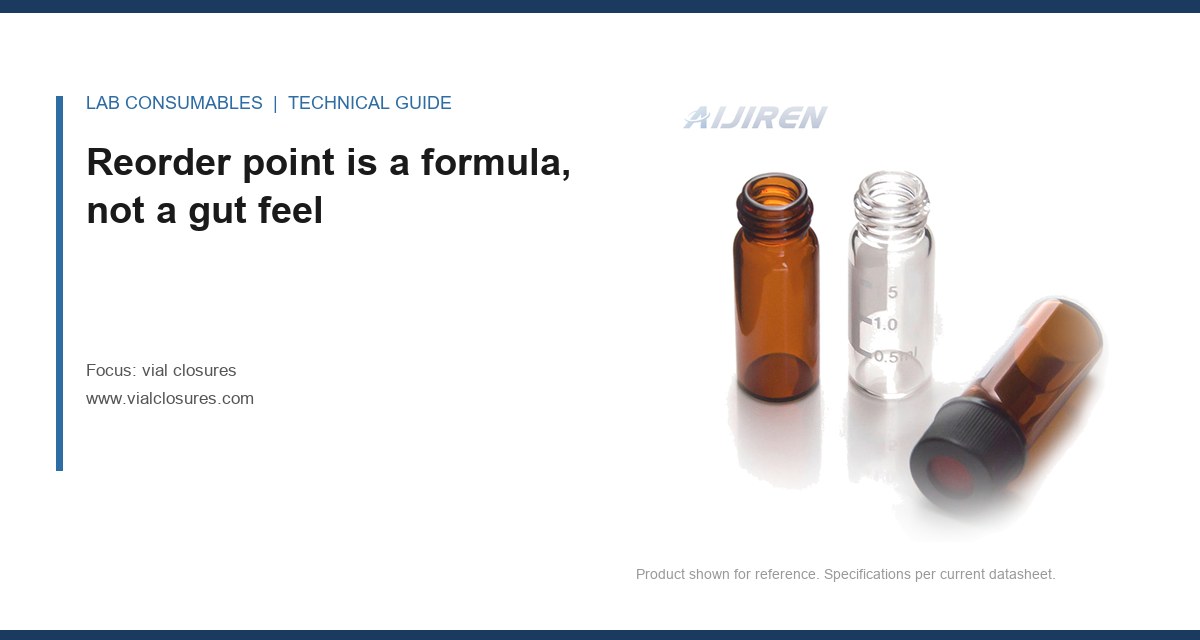
A 27-day stockout on 11 mm crimp seals cost a contract lab I work with $41,000 in expedited air freight and two weeks of pushed turnaround. The trigger was not a supplier failure. Their reorder point was set at 1,200 seals against a 30-day lead time, but consumption had climbed from 340 to 610 seals a week after they picked up a new LC-MS method, and nobody recalculated. The lot ran dry on a Tuesday. The replacement came from a distributor at 2.4x the contracted unit price, and the QC release on the incoming lot added four days. This is a planning problem, not a purchasing problem. Getting vial closures MOQ, lead time, and reorder point planning right is arithmetic, and most labs never do the arithmetic.
I have watched this fail in three different ways over the past decade: a reorder point that was never updated after a method change, a safety stock that was set to “two weeks” because that felt safe, and an MOQ accepted at face value because the supplier’s quote sheet did not show the carrying cost. All three are fixable with a spreadsheet and about an hour of work per format. None of them require a new ERP module or a consultant.
The standard formula is ROP = (average daily consumption × lead time in days) + safety stock. That is the whole thing. The work is in the two inputs, and both are noisier than people assume.
Consumption is not the number your LIMS reports as “vials used.” It is vials used plus the ones you scrap. In a typical HPLC lab running 9 mm screw-thread vials on an autosampler, I budget 4 to 7% scrap for septum coring on repeat injections, plus another 2 to 3% for cracked or contaminated vials pulled at prep. If you inject a sample three times from the same vial with a 22-gauge needle, the septum takes three punctures and the fourth is where you start seeing coring on lower-durometer silicone. That is real consumption and it belongs in the plan.
The scrap rate is format-specific and worth measuring rather than guessing. On 11 mm crimp seals with a 1.0 mm PTFE-faced silicone septum, I see 3 to 5% scrap from incomplete crimps (skirt not rolled over the bead) and 1 to 2% from septum push-through on high-pressure injections. On 9 mm screw-thread with a pre-slit septum, scrap runs lower (2 to 3%) because the slit relieves needle drag, but the pre-slit format costs more per unit and the trade only pays if you are injecting the same vial more than twice. Measure your own scrap for one month on one format. It takes ten minutes at the bench and it will change your consumption number by 5 to 10%.
Lead time is not the supplier’s quoted “4 weeks.” It is order placement to dock receipt, and that includes:
- Order processing: 1 to 3 business days at most manufacturers, longer at the end of a quarter.
- Production queue: 5 to 15 business days for catalog items, 20 to 35 for custom colors or non-standard septa.
- Molding and assembly: already in the queue number for stock items; add 10 to 15 days if the closure is made to order.
- QC release and CoA generation: 2 to 5 days. This is where most people forget to add time.
- Freight: 2 to 4 days domestic ground, 5 to 10 days international air, 25 to 40 days ocean.
I have never seen a supplier’s quoted lead time include QC release and freight. Add them yourself. A “4-week” quote is a 6-week reality for most buyers.
There is one more input that gets ignored: the ordering calendar. If your buyer places orders on Thursday and Friday, those orders sit over the weekend and effectively add two days to every lead time. A lab that orders ad hoc against a 42-day lead time is really running a 44-day lead time on average and a 46-day lead time on the worst orders. Fixing the ordering day to a fixed Tuesday is a zero-cost change that removes 2 to 3 days of variance from the plan.
Safety stock is where lead-time variance lives
Most labs use a flat safety stock of two weeks of consumption and call it done. That is fine if your supplier is reliable and your consumption is stable. It is not fine if either moves.
The defensible method is safety stock = Z × √(LT × σd² + d² × σLT²), where Z is the service-level factor (1.65 for 95%, 2.33 for 99%), LT is average lead time in days, σd is the standard deviation of daily consumption, and σLT is the standard deviation of lead time. If that looks like overkill, here is the working version I actually use:
Safety stock = (peak weekly consumption × peak lead time in weeks) − (average weekly consumption × average lead time in weeks), then round up to the next full case.
For a lab running 610 seals a week with a 6-week average lead time, a 9-week peak lead time during a supplier changeover, and an 800-seal peak week, that is (800 × 9) − (610 × 6) = 7,200 − 3,660 = 3,540 seals. Add the base ROP of 610 × 6 = 3,660 and you land at a reorder point of 7,200 seals. That is a lot of inventory. It is also the correct number if you cannot tolerate a stockout on a validated method.
Run the same arithmetic on a lower-volume format and the numbers tell a different story. A GC lab running 13 mm crimp seals at 90 units a week, with a 5-week average lead time and a 7-week peak, needs (140 × 7) − (90 × 5) = 980 − 450 = 530 seals of safety stock, plus 450 base, for an ROP of about 980 seals. That is under one case on most catalog formats. The point is that the formula scales down as well as up, and a lab running four formats should run it four times.
If you can tolerate a stockout (screening work, non-GLP), the Z-factor version with 95% service gives you roughly half the safety stock of the peak-minus-average method. The point is to choose deliberately, not to default to “two weeks.”
What an MOQ does to carrying cost, in dollars
Here is the number nobody puts on the quote sheet. If your supplier’s MOQ is 10,000 seals and your annual consumption is 18,000, you are buying in lots that turn 1.8 times per year. That means an average on-hand balance of roughly 5,000 seals at any given moment, and you are paying to hold them.
Carrying cost runs 18 to 25% of unit value per year for lab consumables when you count storage footprint, insurance, obsolescence risk (septa have a shelf life, typically 3 to 5 years from manufacture for silicone/PTFE laminates, less for butyl), and the cost of capital. On a $0.11 closure, that is $0.020 to $0.028 per unit per year in carrying cost. On 5,000 average units, that is $100 to $140 per year. Not catastrophic. But the same math on a custom-molded closure at $0.48 each and a 25,000 MOQ against 30,000 annual consumption gives you 12,500 average on hand and $1,080 to $1,500 per year in carrying cost, plus the risk that the method changes and you are holding 12,500 closures you cannot use.
| Scenario | Annual use | MOQ | Turns/year | Avg on-hand | Carrying cost @ 22% |
|---|---|---|---|---|---|
| Standard 11 mm crimp, catalog | 80,000 | 5,000 | 16.0 | 2,500 | ~$60 |
| 9 mm screw-thread, catalog | 18,000 | 10,000 | 1.8 | 5,000 | ~$120 |
| Custom color, 20 mm | 30,000 | 25,000 | 1.2 | 12,500 | ~$1,300 |
| Pre-slit silicone/PTFE, catalog | 45,000 | 20,000 | 2.25 | 10,000 | ~$440 |
The rule: if MOQ exceeds 8 to 10 weeks of consumption, either negotiate it down or find a distributor who will break the case. Most manufacturers will quote a lower MOQ at a modest premium (5 to 12% on unit price) if you commit to a blanket order with scheduled releases. That is almost always cheaper than carrying a year’s worth of inventory.
Work the comparison explicitly. A 25,000-unit MOQ at $0.48 gives you an annual purchase of $14,400 against 30,000 units used, so you buy once and hold 12,500 units for most of the year at $1,300 carrying cost, for a total cost of ownership of about $15,700. Break the order into three releases of 10,000 at a 9% premium ($0.523 per unit) and you spend $15,690 on product, hold an average of 5,000 units, and carry about $530. The premium route is cheaper by roughly $500 a year, and it also gives you three chances to catch a lot problem instead of one. That is the trade in a sentence: a lower MOQ buys you flexibility and catches problems earlier; a higher MOQ buys you a lower unit price and locks you in.
There is a second MOQ cost that does not show up in carrying cost: the obsolescence hit when a method changes. If you are holding 12,500 custom closures and the lab moves to a different autosampler format, you write off the balance. I have seen a 22,000-unit write-off on a custom 8 mm closure after an instrument replacement, at $0.39 per unit, which is $8,580 gone. The carrying cost calculation never captures that. The MOQ decision has to.
Three field cases where the plan broke
Case 1: the drift that looked like a supplier problem
A pharma QC lab reported that their autosampler was capping vials inconsistently. About 1 in 300 caps was not seating. They blamed the closure lot. The measurement that identified the real issue: torque on the capper was 1.4 in-lb, spec was 2.0 ± 0.2 in-lb. The capper had drifted. But the reason it surfaced as a supply complaint was that the lab had switched to a lower-MOQ distributor lot with a slightly different cap skirt thickness (0.2 mm thinner), which reduced the interference fit and made the capper’s drift visible. The fix was two-part: recalibrate the capper to 2.0 in-lb, and add a 0.1 mm skirt-thickness tolerance to the incoming spec. The reorder point was not the problem, but the MOQ decision (buying from a distributor to avoid a 20,000-unit manufacturer MOQ) had introduced lot-to-lot variation the lab had not planned for. That is a real cost of the low-MOQ route, and it belongs in the decision.
Case 2: the lead time that was actually a QC release
An environmental lab running EPA SW-846 methods (see the U.S. EPA SW-846 test methods for the container requirements) set their reorder point at 4 weeks of consumption against a quoted 4-week lead time. They stocked out twice in six months. When I pulled the PO history, the actual dock-to-dock time was 38 to 44 days, not 28. The gap was QC release (5 to 7 days for the CoA on the PTFE-faced silicone septa) plus a Friday-order-placed effect (orders placed Thursday or later sat until Monday). The fix was not a bigger safety stock. It was moving the reorder trigger to a fixed weekly ordering day (Tuesday) and recalculating ROP against a 44-day lead time. ROP went from 4 weeks to 6.3 weeks of consumption, and the stockouts stopped.
Case 3: the blanket order that cut both inventory and price
A contract lab using 9 mm screw-thread vials at 62,000 units a year was buying 10,000-unit MOQs from a distributor at $0.14 per unit and holding 5,000 on average. They had one stockout a year, always in Q4 when the distributor ran dry. I moved them to a manufacturer blanket order of 62,000 units with quarterly releases of 15,500, at $0.118 per unit, with a written 35-day PO-to-dock commitment and a stockout notification clause. Average on-hand fell from 5,000 to about 7,750 (the release size is larger than the old MOQ, so on-hand went up, not down), but the unit price fell 16% and the Q4 stockout disappeared. Carrying cost rose by about $60 a year. The price saving was $1,364 a year. Net, the blanket order won by about $1,300, and the stockout risk went to zero. That is the case for negotiating releases instead of accepting MOQ.
How to set the reorder point when lead time is unstable
If your supplier’s lead time varies by more than 20%, the average is not a useful planning number. Use the 90th-percentile lead time instead. Pull the last 12 receipts, sort by days from PO to dock, and take the 11th value. That is your planning lead time. It will be higher than the average and it will be right.
A worked example: 12 receipts at 28, 30, 31, 33, 34, 35, 36, 38, 40, 42, 44, and 51 days. The average is 36.8 days. The 11th value (second-worst) is 44 days. If you plan against 37 days and the next order comes in at 51, you are 14 days short. Plan against 44 and the 51-day order costs you a week of safety stock, not a stockout. The cost of planning against the 90th percentile is roughly 15 to 20% more safety stock than the average would suggest. The cost of planning against the average is the stockout you already know is coming.
Then layer in the MOQ constraint. Your effective reorder point must be at least one MOQ above the calculated ROP, or you will order below MOQ and pay the premium every cycle. If ROP is 3,660 and MOQ is 5,000, you order 5,000. If ROP is 7,200 and MOQ is 5,000, you order 10,000 (two MOQs) to stay above the trigger. The second case is where carrying cost climbs and where a blanket order with scheduled releases earns its keep.
For labs running multiple vial formats (11 mm crimp, 9 mm screw, 13 mm, 20 mm), set reorder points per format, not per “vial closures” category. A shared safety stock across formats hides the fact that one format is turning 16 times a year and another is turning twice. The vial closures catalog splits by format for exactly this reason, and your planning sheet should too.
What to put in the supplier agreement
The MOQ and lead time you get are the ones you negotiate, not the ones on the website. Five clauses I insist on:
- Blanket order with scheduled releases. Commit to annual volume, release monthly or quarterly. This gets you manufacturer pricing at distributor flexibility. Most suppliers will do this at 12,000+ units annually.
- Lead time defined as PO to dock, not PO to ship. In writing. With a stated QC release allowance.
- Lot traceability with manufacture date. Septa age. A lot manufactured 18 months before shipment has already burned a third of its shelf life.
- MOQ break price schedule. Ask for unit price at 1x, 2x, and 5x MOQ. The curve tells you whether the MOQ is a real production constraint or a sales policy.
- Stockout notification. If the supplier cannot ship within the quoted lead time, they call you before the ship date, not after. This is the difference between a 3-day scramble and a 27-day one.
If you are sourcing through a distributor, confirm the distributor holds stock, not just a catalog listing. The Thermo Fisher chromatography and sample handling and Agilent chromatography consumables and columns lines both publish lead times that differ by format, and the published number is often the manufacturer’s queue, not the distributor’s dock date. Ask for the dock date. The Restek technical resources are also useful for confirming which closure format a given method actually calls for before you commit to a blanket order on the wrong part number. Ordering the right format at the wrong volume is still a planning failure.
Decision checklist: standard vs. custom, and when to hold stock
Use this to decide whether a given closure format should be planned at the catalog level or the custom level.
| Question | If yes | If no |
|---|---|---|
| Annual consumption > 40,000 units? | Negotiate blanket order, quarterly releases | Buy from distributor, accept 5-12% premium |
| Lead time variance > 20%? | Plan against 90th-percentile lead time | Plan against average lead time |
| MOQ > 10 weeks of consumption? | Negotiate lower MOQ or find break-case distributor | Order at MOQ, accept carrying cost |
| Method validated and locked? | Hold 6-8 weeks safety stock | Hold 3-4 weeks, revisit quarterly |
| Custom color or septum? | Add 15-20 days to lead time, 25,000+ MOQ typical | Catalog lead time applies |
| Multiple formats in use? | Set ROP per format | Single-format ROP is fine |
Two operational precautions that come out of this. First, review consumption quarterly against the ROP, not annually. Method changes, new instruments, and sample-volume shifts move consumption by 20 to 40% in a quarter, and an annual review is how the $41,000 stockout happens. Second, hold a documented “no-touch” safety stock that only the lab manager can release. If the safety stock is visible on the shelf, it gets used, and then it is not safety stock. Label the shelf bin with the reorder point and the safety-stock floor, and post the formula on the inside of the cabinet door where the buyer actually looks.
The decision rule
Set the reorder point from the 90th-percentile lead time and peak weekly consumption, not the average, then round up to the next MOQ. If that number exceeds 10 weeks of consumption, the MOQ is too high for your volume and you should either negotiate a blanket order with scheduled releases or move to a break-case distributor. The 27-day stockout was avoidable with a 10-minute recalculation. Do the recalculation every quarter, and put the formula on the planning sheet where the buyer can see it. For the analytical side of what those closures are protecting, the analytical testing and chromatography vial resources cover the method-facing requirements, and the HPLC vial reference covers the autosampler compatibility side. The planning arithmetic is yours to own.
References & further reading
Related resources from our lab consumables network:
- Vial Closures at vialclosures.com
- Analytical Testing at labanalyticaltesting.com
- Chromatography Vial at chromvials.com
- Hplc Vial at hplcvialfactory.com
External references and standards: